
Tiwanaku Bolivia
1,000 years before Columbus discovered the Americas, Tiwanaku was an important religious and trading city. Its power and influence spread across Bolivia, southern Peru, northern Chile and parts of Argentina.
The people of Tiwanaku lived in rectangular homes made of adobe, a material consisting of sun-dried clay and straw. Their city was filled with lively markets and paved streets. Towering over the city were large stone palaces, pyramids and temples.
The city was prosperous. Everyone had plenty of potatoes, quinoa, corn and meat to eat. Tiwanaku consisted of many skilled craftsmen, exceptional architects, influential traders and thriving farmers. For a long time, stories of their ancestors were passed down from generation to generation without any written language. All was well for Tiwanaku.
But then something mysterious happened. Tiwanaku disappeared after its 1,500 glorious years.
How did Tiwanaku disappear?
The mystery of Tiwanaku is still unsolved although there are many theories. Some archaeologists and scientists have claimed that climate change led to an extensive drought that wiped the people out. Others have concluded a deadly disease or a catastrophic earthquake could have caused their disappearance.
Where is Tiwanaku today?
Tiwanaku is located in the high plains, known as the Altiplano of Bolivia, 12,631 feet above sea level. It is about 42 miles from La Paz and six miles from the southern banks of Lake Titicaca. There aren’t many trees in the Altiplano but you can see llamas and alpacas grazing in the plains just like they did in ancient Tiwanaku.

Today, most of Tiwanaku is buried under towns and villages. A small area has been turned into an open-air museum. This area is an important archaeological site and a major tourist attraction in Bolivia. Tourists, students, and archaeologists visiting the area can view the ruins of Tiwanaku.
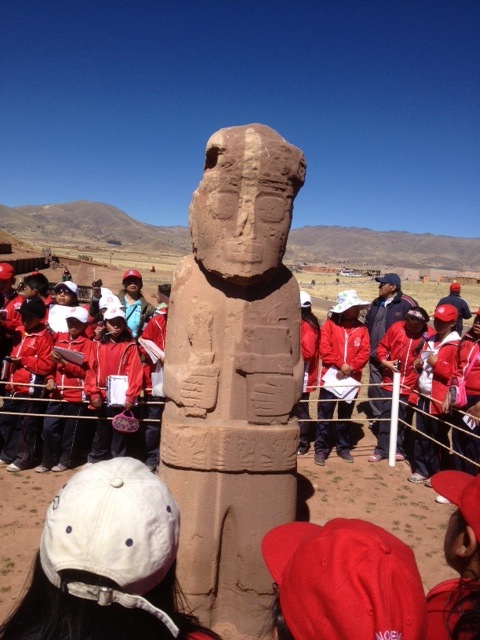
The natives of this area are the Aymara people, descendants of the Tiwanaku. In contrast with their ancestors, the Aymaras are the poorest people in Bolivia. They are farmers who work on small plots of land. Almost all do not have modern machinery like tractors. They use their hands and simple tools to farm.
Which ruins can be seen in Tiwanaku open-air museum?
The Pyramid of Akapuna during Tiwanaku’s glorious years was 56 feet tall and 60 feet wide on each side. It had seven platforms, one laid over the other like seven gigantic steps. Only the lowest of the platforms survived. Currently, the reconstruction of the Pyramid of Akapuna is underway as men and women dig and lay bricks to rebuild the pyramid.

Pyramid of Akapuna
An important monument in Tiwanaku is the Gate of the Sun. Archaeologists and historians believe that the carvings on this 10 foot high and 11 foot wide single stone block represent a highly regarded Tiwanaku god. They also believe that the carvings around the god may have been used as an agricultural calendar.

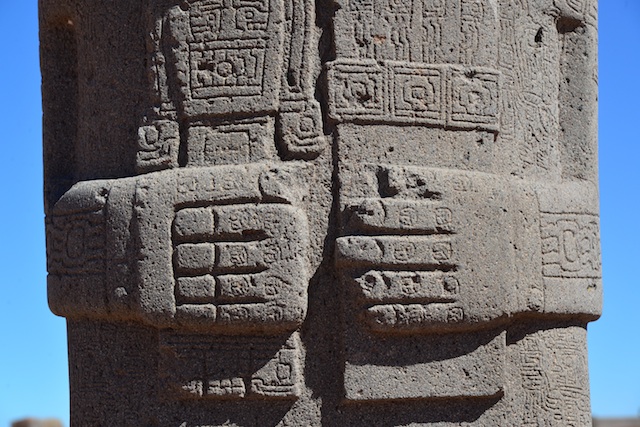
Inside Kalasasaya temple is the Ponce Monolith, standing at about 10 feet tall. Ponce Monolith is a pillar with detailed carvings of a man. You can see the hands, head, arms, legs, long braided hair, a crown on his head, and a pierced lower lip with a ring. His left hand held a keru (a ceremonial cup) and his right hand held a piece of wood.
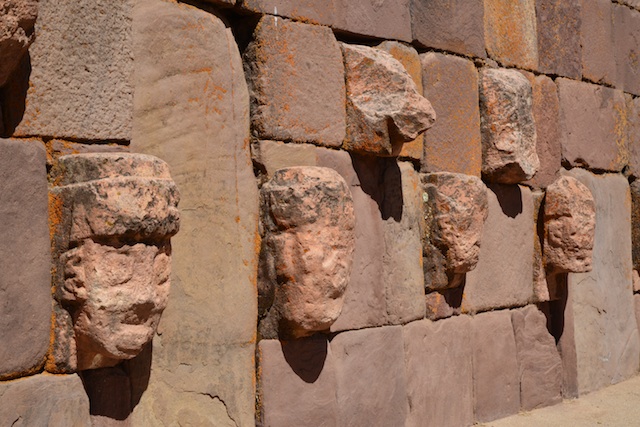
Next to Kalasasaya is the semi-underground temple, a large sunken courtyard. Its walls are covered with 175 protruding carved faces and skulls.
Efforts are now being made to preserve and reconstruct the ancient city of Tiwanaku. Could the Tiwanaku preserve their city if there was a written language? Would the mystery be solved?
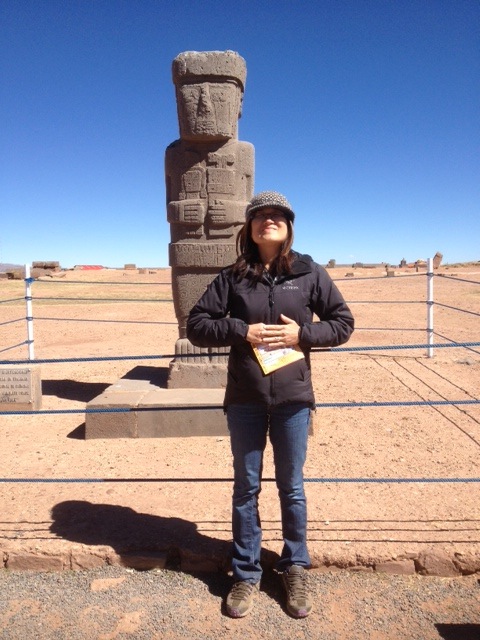
Have you been to Tiwanaku Bolivia? What are your thoughts about this historical site?


Leave a Reply
You must be logged in to post a comment.