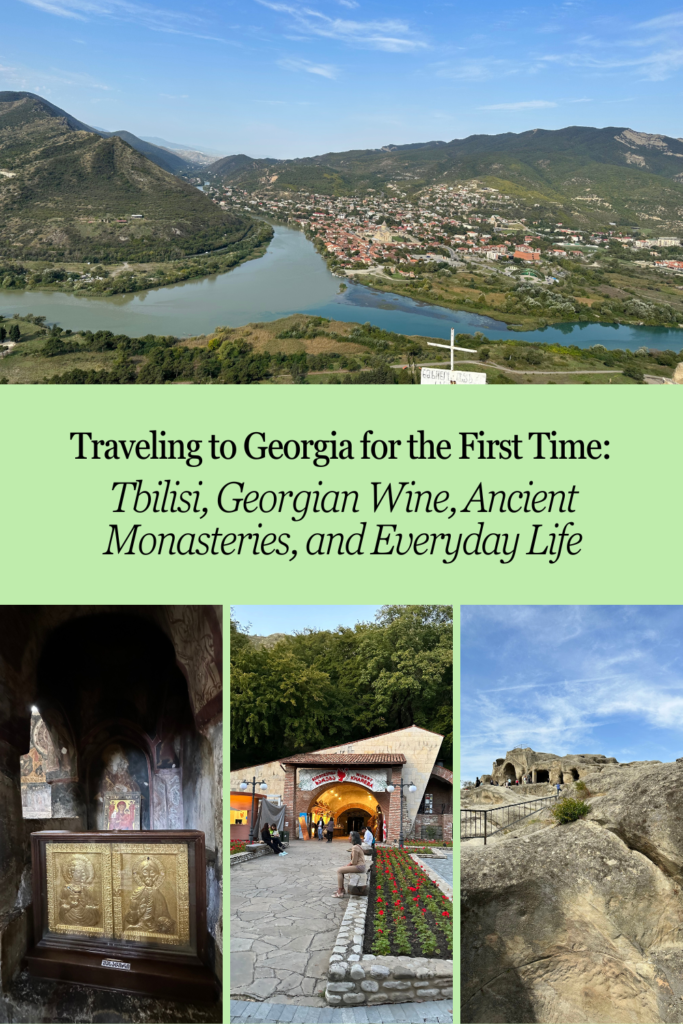
Traveling to Georgia for the first time feels like stepping into a country where history, hospitality, and daily life are inseparable. From walking through Old Tbilisi and riding a cable car above the river, to tasting wine made using 8,000-year-old methods and exploring UNESCO-listed religious sites, Georgia reveals itself slowly and generously. This journey through Tbilisi and its surrounding regions became one of the most memorable chapters of my Caucasus trip.
Crossing from Armenia into Georgia
We crossed from Armenia into Georgia via the Bagratashen–Sadakhlo border crossing, the main and most commonly used land border between the two countries. The process was smooth and efficient, making it an easy transition even for first-time travelers combining Armenia and Georgia on one trip.
From the border, we continued on to Tbilisi, arriving in the afternoon. Our base in the city was Cherry Garden Hotel, located at 28/30 Anton Chekhovi Street. Set on a quieter street but within easy reach of Old Town, it was a comfortable and well-located hotel for walking-intensive days and late evenings in the city.
After a short rest, we met our guide in the hotel lobby and began our first exploration of Tbilisi on foot.
Day One: Walking Through Old Tbilisi From Above to Street Level
Our introduction to the city began at the Metekhi Plateau, a 13th-century site overlooking the Mtkvari River. From this vantage point, Tbilisi immediately reveals its layered identity. Churches, modern buildings, balconies, and winding streets all coexist in a way that feels organic rather than planned.
From Metekhi, we walked toward Rike Park, a modern green space along the river. Here we stopped at the Tree of Life sculpture, a contemporary artwork symbolizing continuity, renewal, and Georgia’s deep-rooted connection between past and present. Its placement is intentional. Surrounded by ancient landmarks yet standing in a modern park, it reflects how Georgia does not separate history from daily life, but allows the two to exist together.
From Rike Park, we boarded the cable car to Narikala Fortress, one of the highlights of the day. The ride itself was unforgettable. As we rose above the river, sweeping views opened up across Old Tbilisi, revealing red rooftops, cathedral domes, and the curve of the Mtkvari below. The cable car offers one of the most beautiful introductions to the city.
At the top, Narikala Fortress, originally built in the 4th century, dominates the skyline. From here, we could also see Kartlis Deda, the Mother of Georgia statue, standing above the city holding a sword for enemies and a cup of wine for friends. It is one of Georgia’s most powerful national symbols and perfectly captures the country’s spirit.
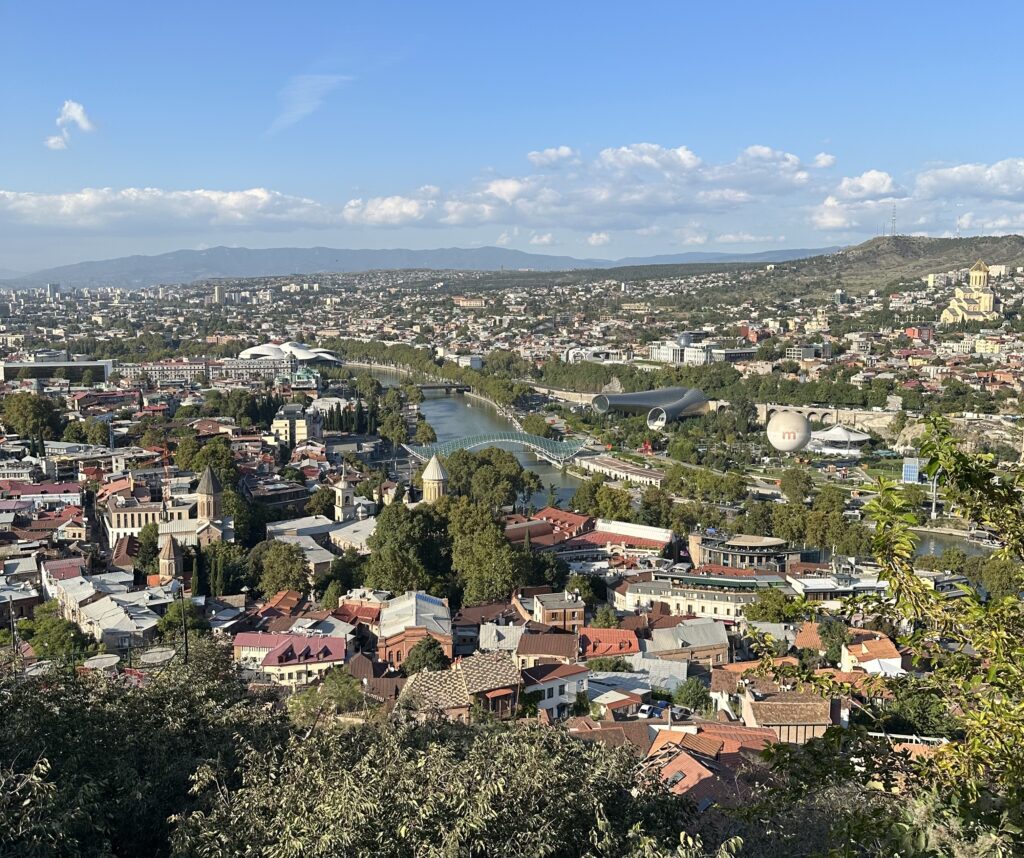
Instead of returning by cable car, we walked downhill toward Old Town. This descent was one of the most interesting parts of the day. Along the way, we passed small neighborhood shops, old wooden houses with carved balconies, and everyday apartment buildings that felt lived-in rather than preserved.

As we reached street level, the energy shifted. Erekle II Street, Rkinis Rigi, and Jean Chardin Street were lined with restaurants, bars, and cafés, already filling with people as evening approached. These streets form the social heart of Old Tbilisi, where food, conversation, and wine stretch late into the night.
We continued walking toward the Bridge of Peace, arriving just as the sun began to set. Crossing the bridge at dusk was a beautiful moment. The modern glass-and-steel structure glowed softly, offering views back toward both the historic Old Town and the newer parts of the city.
At around 6:45 pm, we gathered at Gabriadze Square to watch the Clock Tower of the Rezo Gabriadze Marionette Theater chime at 7 pm. Locals still pause here daily, and the whimsical, leaning tower feels playful while reflecting Georgia’s deep appreciation for storytelling and art in public spaces.
As night fell, we passed the Lamplighter Monument, which commemorates the lamplighters who once walked the streets of Tbilisi at dusk, lighting oil lamps one by one before electricity existed. Lamplighters were familiar figures in the city, marking the transition from day to night and ensuring streets were safely illuminated. The monument honors this vanished profession and adds another quiet layer to Tbilisi’s storytelling.
It had been a long day, and we ended the evening with dinner at Maspi, one of the oldest restaurants in Tbilisi. Traditional Georgian music, flowing local wine, and classic dishes created an atmosphere that felt celebratory without being staged. Georgian dining is meant to be shared and lingered over, and Maspi embodied that spirit perfectly.
Day Two: Georgian Wine and the Kakheti Region

After breakfast, we drove east into the Kakheti region, Georgia’s premier wine-producing area and one of the most historically rich parts of the country. Georgia is widely regarded as the birthplace of wine, with archaeological evidence showing uninterrupted winemaking traditions dating back more than 8,000 years.
Our first stop was Alaverdi Monastery, built in the 11th century and once one of the tallest structures of its time. The monastery courtyard is surrounded by vineyards, where monks still produce wine today. Here, wine is not a trend or luxury. It is part of spiritual life and daily rhythm.
Next, we visited the Gremi Monastery Complex, once the capital of the Kakheti Kingdom between the 15th and 17th centuries. Though much of the town was destroyed during invasions, the remaining structures offer insight into Georgia’s medieval political and cultural life.

One of the highlights of the entire Caucasus journey was Khareba Winery, located inside a tunnel carved directly into the Caucasus Mountains. Inside the tunnel, we learned about the history of Georgian winemaking and the qvevri method, a UNESCO-recognized tradition in which wine is fermented and aged in large clay vessels buried underground.
The tunnel maintains a naturally cold temperature year-round, so cold that we were given blankets during the wine tasting. As we sampled the wines, we learned how qvevri winemaking allows grape skins, seeds, and juice to ferment together, producing wines that are earthy, structured, and deeply connected to place.
We continued on to Tsinandali Estate, once owned by the 19th-century aristocratic poet Alexander Chavchavadze. The estate includes a family museum and beautifully landscaped gardens laid out in English style, complete with exotic plants and sweeping viewpoints. Tsinandali represents the refinement of Georgian wine culture, blending tradition with European influence.
That evening, we returned to Tbilisi.
Day Three: Mtskheta, Stalin’s Birthplace, and Ancient Cave Cities
After breakfast, we set out for Mtskheta, the ancient capital of Georgia and one of its most important religious centers. Now a UNESCO World Heritage Site, Mtskheta sits at the confluence of the Mtkvari and Aragvi rivers.
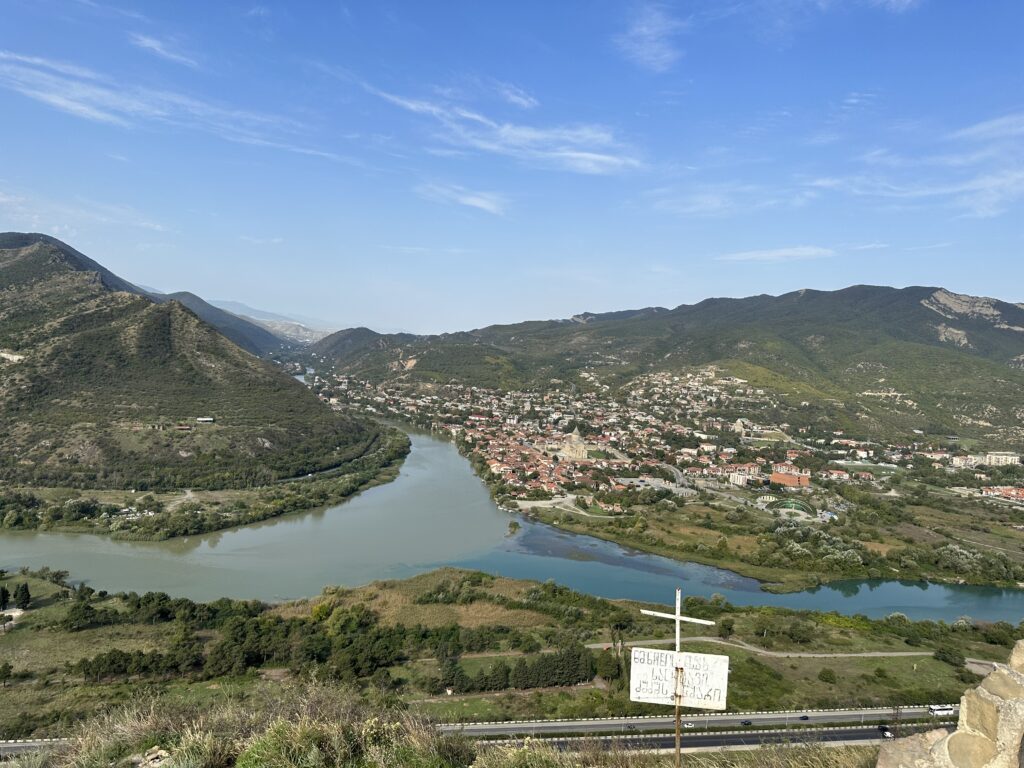
We stopped at Jvari Monastery, built in the 6th century and perched high above the rivers. The view from here is one of the most iconic in Georgia, where the two rivers meet below the monastery.

From there, we drove to Gori, the birthplace of Joseph Stalin. At the Stalin Museum, we saw the modest house where he was born, preserved beneath a protective structure, as well as Stalin’s personal train carriage, which he used for travel due to a fear of flying. The museum offers a complex and sometimes unsettling look at one of the most controversial figures of the 20th century.

Nearby, we visited Uplistsikhe, an ancient cave city carved into rock and dating back to the first millennium BC. Before Georgia became Christian, this site was used for pagan rituals and early urban life. Walking through its carved passageways feels like stepping into another era entirely.
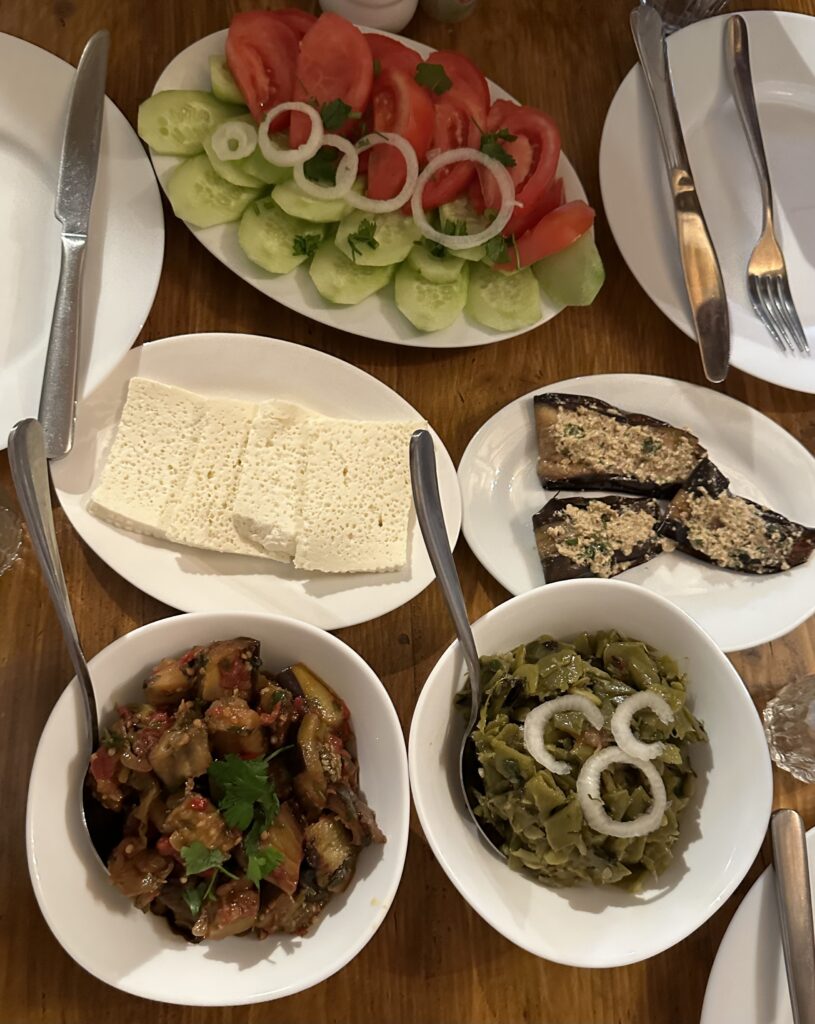
We stopped by for late lunch at Salizvari. Salizvari was, without hesitation, the best food and wine experience I had in Georgia. Tucked into the Kakheti countryside, this restaurant delivers everything I love about Georgian cuisine—deeply flavorful dishes, beautifully balanced wines, and a sense that nothing here is rushed or commercial. Every plate felt intentional, every glass poured with pride, making Salizvari the place I still think about when I think of Georgian food done at its very best.

After our late lunch, we went back to Mtskheta again where we visited Svetitskhoveli Cathedral, built in the 11th century and believed to be the burial site of Christ’s robe. It remains a living place of worship and a cornerstone of Georgian Christianity. We also walked through the narrow streets of the town, where small shops sell souvenirs and locally made goods, and even wine ice cream.

That evening, we returned to Tbilisi for our final overnight stay.
The Night Before Departure: Dinner at Linville Cafe
The night before our departure, we had dinner at Linville Cafe, one of the most atmospheric places we visited in Tbilisi. The cafe is housed inside an old Georgian house and feels far more like a home than a restaurant.

To reach the dining area, we climbed crooked wooden stairs leading to the second floor. Inside, the space opened into several rooms, each furnished differently, with sofas, round tables, square and rectangular tables, and a small balcony with just a few round tables overlooking the street. The rooms flowed naturally into one another, as if the house had simply evolved into a cafe over time.
One of the most charming details was a fish tank made from an old television, quietly glowing in one corner. It was playful, unexpected, and perfectly in tune with the spirit of the place. The atmosphere was relaxed and unpretentious, filled mostly with locals lingering over wine and conversation.
For dessert, we tried Pelamushi, a traditional Georgian sweet made from thickened grape juice and flour, often with walnuts. Smooth and gently elastic, with a deep grape flavor, it reflects how closely Georgian desserts are tied to wine culture and harvest traditions.
A Free Day in Tbilisi and Departure to Baku
Our final day in Tbilisi was largely free, allowing us to roam the city on our own. Without a schedule, we revisited favorite streets, lingered in cafés, and enjoyed the city at a slower pace. It felt like a chance to live in Tbilisi rather than just visit it.
That evening, we gathered our bags and headed to the airport for a late-evening flight with Baku Airlines, leaving Georgia behind and continuing on to Baku, the final chapter of the Caucasus journey.
Final Reflections on Georgia
Georgia is expressive, layered, and deeply proud of its traditions. Wine is not a trend here. It is heritage. Food is not rushed. It is shared. History is not confined to museums. It is part of everyday life.
Leaving Tbilisi felt less like moving on and more like closing a chapter, one that made the Caucasus feel richer, deeper, and far more personal than I had expected.


Leave a Reply
You must be logged in to post a comment.